


I was lied to.
And now I must deal with the resentment.
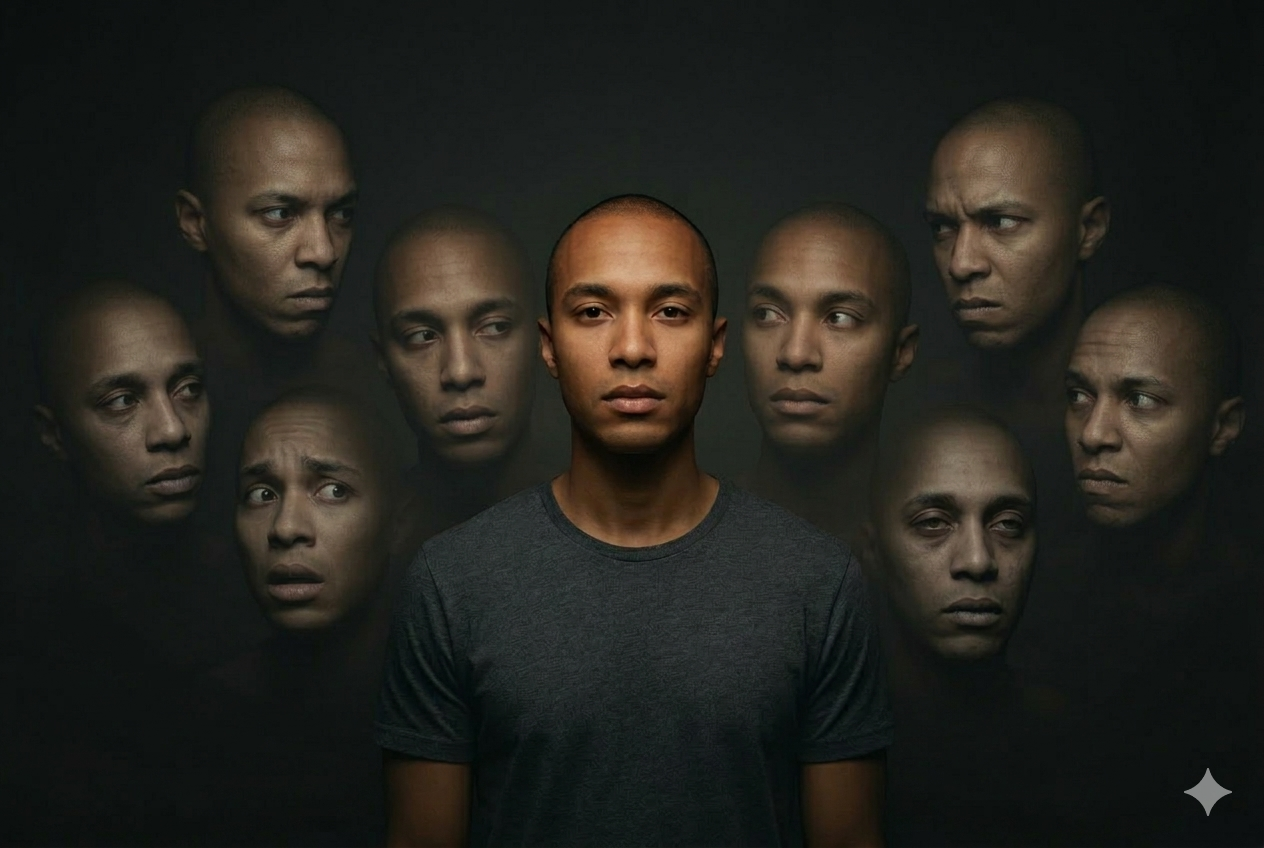
The lie? “Be normal.”
From my earliest memories, I was told to “fit in,” to “act normally.”
Problem is, I wasn’t normal. At least not in the normal sense of, well, normal. This was true before I came to faith, and it is even more true now that I am maturing in my faith.
The pressure to fit in was implicit and explicit. It came from individuals, groups, and culture at large.
Only recently have I come to fully appreciate just how different I am. A convergence of facts and experience fully confirmed that my brain does not work like what “normal” appears to be. I’m not suggesting better, only different.
The pressure to normalize rarely came with clear definition. Sometimes it lacked a subject entirely: Physically? Psychologically? Intellectually? Emotionally? Socially?
But the greatest problem for me wasn’t the pressure to fit in — it was my response. Of all the resentment I am experiencing, the resentment toward self is perhaps the greatest.
I never developed a sense of self independent of those around me, of the conditions I found myself in. I was a social, intellectual, and emotional chameleon. Over time, I learned how to act in a given situation. I could act normal in common scenarios. It was the outliers that threw me. Without a historical reference point, without a learned response, new situations could be very challenging.
But some of those closest to me never asked what normal was for me. They never considered the obvious difficulty I had with certain things. They just expected me to learn how to act.
And I did. Sadly.
I bought into the lie. The lie of normal.
But now, a decade into my walk with Christ, I have felt the sharp cut of “be normal” once again.
I have had self-proclaimed Christians tell me I was going to hell because I chose not to attend a “Sunday morning church” (SMC). I’ve had others, upon hearing my story, tell me that I was listening to Satan and not God. This, of course, is always a possibility to be guarded against. But prayer and careful reading of Scripture gave me peace with my decision.
I have been maligned and attacked for taking a personal approach to my faith. I have not attended an SMC in over two years. I have not missed it. In fact, my spiritual growth accelerated after stopping regular attendance. Do I recommend everyone stop attending? Absolutely not. Do I judge those who do attend? Again, no.
But I know what is right for me. I know what has worked and pulled me closer to God, and what has not worked, and pushed me away from the incredible peace of proximity.
Society at large, culture, demanding normalcy — I can almost get that. But the church? Christians? Oh, how the resentment has grown.
Scripture gives us the model for how we are to be common — pursuing a life lived as Jesus lived, as described in Scripture. This is the “normal” for Christ followers.
But Scripture also gives us evidence of a specific plan for each of us:
For we are God’s handiwork, created in Christ Jesus to do good works, which God prepared in advance for us to do.
For just as each of us has one body with many members, and these members do not all have the same function, so in Christ we, though many, form one body, and each member belongs to all the others. We have different gifts, according to the grace given to each of us.
A specific call, dependent upon not just Scripture, but the indwelling of the Holy Spirit. Scripture sets the character and boundaries of the path; the Spirit reveals its specific shape for each of us.
So how is it then that so many Christians have reduced following Christ into a few rules? A common set of actions? When we act this way, are we not back to the Pharisees? Following the law for the sake of the law instead of seeking to know God?
This is why my resentment toward those calling for “normal” in the Christian realm is greater than toward culture at large. We should know better.
Church 52 times a year. Tithe 10%. Small group every week, except for the time off in summer so we can travel. Read the Bible. Read devotionals. Serve in the church…
Each of these can contribute to our spiritual maturity. But none of them *are* the maturity. There is no normal set of actions that can produce a close relationship with God.
Even those who matured into a “union” of wills with God — the mystics of the past — have divergent paths to that union. Each clearly states that their experiences are their own, and others should not try to imitate or follow their path.
I first experienced the Holy Spirit while sitting in an SMC. At the time, I didn’t know what it was. That realization came later. SMC has its place. But it is not the end.
Every student in the United States is given the option of attending kindergarten. Ideally, most students receive the same type of instruction at that age. But the further along in education we go, the greater the divergence. Classes aligned with interest. Challenges aligned with gifts.
So why don’t Christians expect the same? Paul calls for believers to progress from “drinking milk” to “eating meat.” Why is the normal in many Christian circles the perpetuation of milk drinkers? Why do we settle for so little when the “meat” is there to be had?
Might I offer a theory? Is it possible that going your own way, following the path God has for you, takes far more work and sacrifice than 52 weeks of SMC each year? What happens when “your path” requires leaving a job? Ending a friendship? Moving across the country, or across the globe? Or perhaps something more drastic: complete death to self and abiding in Christ?
Community is important. Scripture calls us to gather. Accountability is necessary. But all of those things can be found outside of a SMC. Find what works to move you from “milk” to “meat”.
Don’t be like me. Don’t waste years trying to fit into the lie. My recent realizations forced the resentment of the past to the forefront. But they also gave me a path toward releasing it. Forgiveness is not demanded, for most were trying to do what they thought was best. But releasing the resentment — with the understanding that God may be using all of this for His purpose — is sufficient.
As he went along, he saw a man blind from birth. His disciples asked him, “Rabbi, who sinned, this man or his parents, that he was born blind?” “Neither this man nor his parents sinned,” said Jesus, “but this happened so that the works of God might be displayed in him.”
Seek God. Seek to know His Spirit. Seek your purpose as He defines it.
But just know — it won’t come easy.
Search all posts
This Post
Other Posts

aka: When All the Gates Are Closed

aka: When the Trail Runs Cold
Related Posts
-
aka: When All the Gates Are Closed
-
aka: When the Trail Runs Cold
Given I operate a non-profit Christian community and other entities, I feel compelled to offer this disclaimer: The opinions expressed on the BFAdams.blog site are my personal opinions. My posts about secular issues are not reflective of the position or leadership of any entity I may be involved with.
And Jesus said to them, “Render to Caesar the things that are Caesar’s, and to God the things that are God’s.” And they were amazed at Him. – Mark 12:17




I really enjoyed this. As another who is condemned for not going three times a week I struggled with what is acceptable and taught versus what the Bible actually teaches. If I hadn’t started reading my Bible and left compulsory church attendance; I wouldn’t have made it. I’m sure my sins glare obviously to the next person as much as they are hidden to me, but when the world and its organizations are offering cruelty and the church is the cheerleading, it’s best to just get alone with God.