

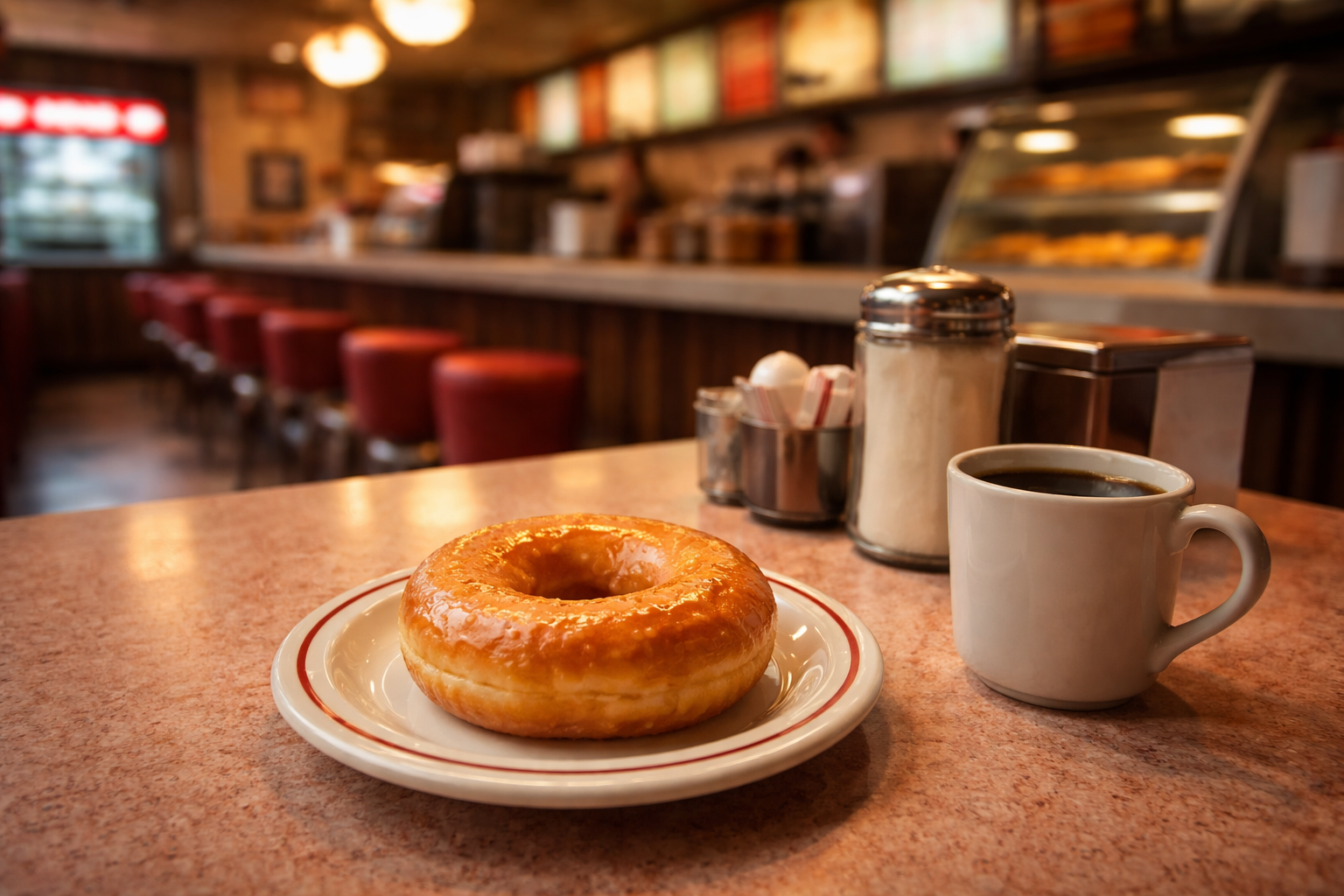
It started with a donut.
I was driving down the road and passed a favorite donut shop. Normally, seeing their sign would trigger the urge to pull in and grab a donut—or a dozen.
But not that day.
The urge was gone.
I wasn’t trying to cut out donuts because of a diet (though it wouldn’t hurt). Donuts were a fun part of the time I spent with my adult daughter. When we found ourselves in the same town, we would almost always find a reason to stop at a donut shop. Donuts weren’t something I “needed” to stop eating, and they held an occasional happy place in my day-to-day life.
So why the sudden lack of desire?
Delight yourself in the Lord; and He will give you the desires of your heart.
This verse became foundational early in my walk with God. I may have shared this elsewhere, but I heard a preacher teach on this passage early on, and the nuance he explained resonated deeply with me: God does not give you what you want in your worldly heart. Rather, God gives you new desires—desires that align with what He wants for you.
God invites us into an exchange: our desires for His.
That day, driving past the donut shop, God whispered something quietly but clearly: I can do more of this, if you will allow me. He took away my desire for donuts—not to replace it with a desire for a better diet, but to show me the gentle authority He could exert over my longings.
So then, my beloved, just as you have always obeyed, not as in my presence only, but now much more in my absence, work out your salvation with fear and trembling; for it is God who is at work in you, both to will and to work for His good pleasure.
Honestly, I didn’t miss the donuts much. I still have one from time to time, but the urge never returned.
But what happens when God calls you to surrender something far more significant than your love of donuts?
How do you respond when God asks you to change careers—or step away from a relationship with someone you love?
In the years since that small lesson, God has asked me to accept many changes: where I lived, where I worked, and who I interacted with. Each began the same way—by hearing the call. Then came resistance and foot-dragging. I even tried negotiating and arguing a few times. (For what it’s worth, I’ve lost every battle I’ve ever fought with God—but I’m persistent.)
As the scope of the “asks” grew, so did the sense of loss.
One of the earliest losses involved a long-term friendship. I was asked to step away completely. No explanation was given, and no words were permitted from me to the other person. I was not to explain or justify. I was to walk away.
The sense of betrayal felt heavy.
The sense of loss felt heavier.
Yet the loss was external. I had lost friends before. This kind of loss was familiar. What I was not prepared for was the loss of part of myself.
Remorse intensifies when what you lose is not merely external—when it is bound up with your sense of self. This is not “church talk.” It isn’t metaphorical. It is real and tangible.
That, however, is not the way of life you learned when you heard about Christ and were taught in him in accordance with the truth that is in Jesus. You were taught, with regard to your former way of life, to put off your old self, which is being corrupted by its deceitful desires; to be made new in the attitude of your minds; and to put on the new self, created to be like God in true righteousness and holiness.
“To put off your old self, which is being corrupted by its deceitful desires.” Scripture returns to this call again and again precisely because it is difficult, painful, and filled with remorse.
At least, it had been for me. Until recently.
I found myself at a crossroads, forced into a clear dilemma: hold onto a deeply important relationship—or be obedient. This was not a direct call to “walk away” from the relationship. Instead, it was a call to purchase a property in a new state—at a distance that would have made continuation of the relationship impossible.
There was no middle ground.
There was no argument to make.
I had to choose.
I chose obedience. I decided to move forward with the purchase of the property. After speaking with the real estate agent to discuss next steps, I began the four-hour drive home.
And to my great surprise, the remorse over the potential loss of the relationship was missing. Intellectually, I understood the loss. But emotionally, spiritually, experientially, the regret wasn’t there.
The detachment from the old way of holding the relationship was complete—and it occurred without remorse.
During the four-hour drive home, something shifted. The sense of God’s presence changed—not absent, but different. By the time I reached home, I knew: I was not to purchase the property after all. God had tested me. Would I choose obedience over preservation? I had chosen obedience.
And in that choice, something broke free.
“The soul that is attached to anything, however much good there may be in it, will not arrive at the liberty of divine union.” — St. John of the Cross, The Ascent of Mount Carmel, Book I, Chapter 11
What does this mean for the relationship? I don’t know yet.
It does mean that I now see it differently. The old self is no longer part of the equation. God’s will—shared with me and expressed through me—reshapes the relationship, giving it a new center and a new freedom.
And this wasn’t the first relationship to undergo this kind of detachment. Over the past decade, in one form or another, nearly all of my relationships have experienced a similar transition, if less extreme. As with the donut, this moment wasn’t ultimately about the relationship—or the land.
It was about the lesson God was teaching through surrender and obedience.
“Let nothing disturb you,
let nothing frighten you.
All things pass away;
God never changes.
Patience obtains all things.
Whoever has God lacks nothing;
God alone suffices.”
— St. Teresa of Ávila (Nada te turbe)
Over these years of small surrenders and large ones, I’ve begun to see the pattern. Detaching yourself from everything you were, everything you held as true and valuable, is the only way to free up space for God. Sometimes He takes it away entirely. Sometimes He returns it renewed, transformed into something I wouldn’t have recognized before. But always—always—He fills that space with more of Himself.
Detachment without remorse is not indifference. And not all detachment is loss.
It is freedom.
I still drive past that donut shop from time to time. The sign still doesn’t trigger anything. And I’m learning to recognize that quiet absence—that gentle freedom—as the sign of something deeper at work.
Now I want a donut….
Donut shop image created using ChatGPT 5.2. Post edited with ChatGPT and/or Claude
Search all posts
This Post
Other Posts

aka: When the Trail Runs Cold


Related Posts
-
aka: When the Trail Runs Cold
Given I operate a non-profit Christian community and other entities, I feel compelled to offer this disclaimer: The opinions expressed on the BFAdams.blog site are my personal opinions. My posts about secular issues are not reflective of the position or leadership of any entity I may be involved with.
And Jesus said to them, “Render to Caesar the things that are Caesar’s, and to God the things that are God’s.” And they were amazed at Him. – Mark 12:17